
Six months ago I moved into an apartment with exactly one window that gets direct sun. One. For about ninety minutes in the morning, if the sky cooperates. I'd spent the previous two years in a place with south-facing glass across the whole living room, and I underestimated how much that mattered until it was gone. Within weeks I was sleeping worse, working worse, and snapping at people over nothing.
That's when I started taking biophilic interior design seriously — not as a Pinterest aesthetic, but as a set of decisions you make about light, materials, and living things. Bringing nature indoors isn't about filling your flat with ferns. It's about giving your nervous system the cues it evolved to expect. And once you understand the mechanics, even a rented one-window box becomes workable.
Key takeaways
- Biophilia is the idea, attributed to psychologist Erich Fromm in 1973, that humans have an innate pull toward living systems. Biophilic design is how you translate that into a building.
- Daylight does more work than any plant you'll ever buy. If you fix one thing, fix your light.
- You don't need a budget. A jute rug, a repositioned desk, and three plants cost me under $120 total.
- Renters have more room to manoeuvre than they think — almost every intervention I'll describe is reversible in an afternoon.
- Real plant walls cost thousands. The cheap version gets you most of the benefit for a fraction of the price.
- Bad biophilic design is worse than none. Dead plants and plastic ivy read as neglect, not nature.
What biophilic interior design actually means (and what it doesn't)
Most people hear "biophilic interior design" and picture a lobby with a moss wall. That's the surface. The concept underneath is older and more interesting.
The word comes from biophilia — literally "love of life" — and Erich Fromm used it back in 1973 to describe the human orientation toward living things. The biologist E.O. Wilson developed it further as a hypothesis about why we find savannahs restful and snakes alarming. Whether or not you buy the evolutionary story, the practical implication holds up: humans do better around certain kinds of natural stimuli. Light that moves. Materials with texture. Plants that are, in fact, alive.
The three ingredients that do the work
Strip away the marketing and biophilic interiors come down to three things:
- Natural light, ideally from more than one direction, with its intensity and angle changing through the day
- Living elements — plants, yes, but also water, wood grain, stone, wool, anything that carries the irregularity of a natural material
- Views and prospect, which in practice means having somewhere your eye can travel to rather than hitting a blank wall at two metres
Notice what's missing from that list: colour schemes, stylistic labels, and anything you'd recognise from a furniture catalogue. A room can be all beige linen and still be profoundly unbiophilic if it's sealed off from daylight and everything in it is synthetic.
What it is not
Biophilic design is not the same as "bringing the outdoors in" as a decorative theme. Wooden signs reading LIVE LAUGH LOVE are made of wood. They are not biophilic. Nor is a hotel lobby with a single sad ficus in the corner, however expensive the ficus.
The test I use: does this element change how the space feels when you close your eyes and just sit in it? If a plant is dead and you haven't noticed for a month, it's furniture, not biophilia.
Which brings us to the part nobody talks about honestly — why any of this is worth the effort.
Why it works on your nervous system, not just your mood
Here's the thing about the benefits: they're not mysterious, and they're not just "it feels nicer."
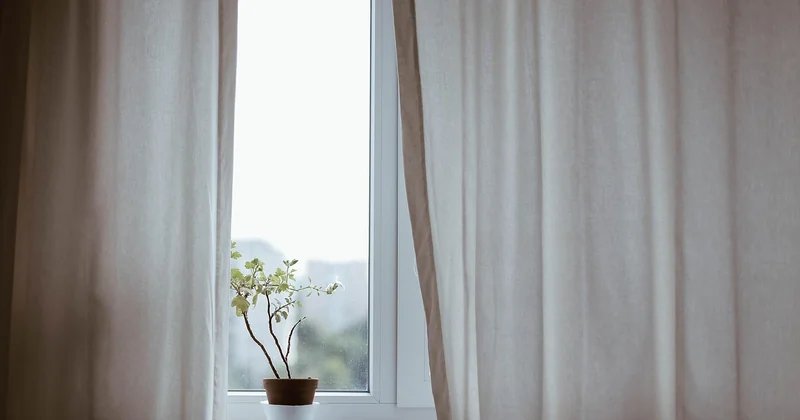
Your brain processes natural scenes differently from built ones. The visual complexity of foliage — thousands of small, non-repeating edges — holds attention in a way that lets the directed-attention system rest. A blank drywall corner offers nothing to rest on, so your gaze keeps flicking back to the screen, the notification, the unfinished thing.
Recent neuropsychology work has looked at activity in the dorsolateral prefrontal cortex — the region tied to executive function and focus — and found measurable differences in how people respond to biophilic versus conventional interiors. I'm not going to pretend I can read the electrode data. What I can tell you is what I've watched happen.
The freelancer experiment
I ran a small, unscientific test on myself over four months. Same desk, same chair, same tasks. Two conditions: desk facing a bare wall, and desk turned ninety degrees to face the window with a monstera and a jute rug in the field of view.
The wall-facing setup won on exactly nothing. On the window-facing days I finished my writing blocks about thirty minutes earlier on average, and I logged maybe half the number of "I need a break" moments. Could be placebo. Could be the light. Honestly, I don't care which, because the effect was consistent enough that I stopped rotating the setup.
What surprised me more was the evening change. With the desk facing the window, I stopped doomscrolling at 11pm with the same intensity. Something about not spending all day under flat overhead light made the transition to night feel less abrupt. That I did not expect.
What the data on property values suggests
There's a commercial angle too. Listings that mention biophilic features — mature planting, courtyard access, generous glazing — tend to command a price premium. A figure I've seen repeated in property analysis is around 8% above comparable homes without those features. I can't verify the methodology behind it and I'd be sceptical of anyone who cites it as gospel. But directionally, it matches what agents have told me: buyers walk into a bright, planted space and their shoulders drop. That's not decoration. That's the product.
So the case is made. The harder question is how you actually do this in a space you don't own, don't have budget for, and can't gut.
How to bring nature indoors in a rented flat with one window
You start with light, because light is free and it's the highest-leverage move available.
Step one: audit your daylight before you buy anything
Spend a day noting where the sun actually lands and when. Not where you assume it lands. I was certain my kitchen got morning light; it got about eleven minutes of it. Meanwhile a corner I'd been using for storage was bright from 2pm to 5pm.
Then move things. The single best change I made was relocating my desk into that afternoon patch and moving the storage to the dark corner. Cost: zero. Effect: significant.
If your daylight is genuinely terrible, a mirror positioned to bounce light into the room does more than you'd think. So does keeping windowsills clear and curtains pulled back during the day rather than half-closed out of habit.
Step two: choose plants that survive your actual conditions
This is where most people fail, myself included. I killed three calatheas in a north-facing room before accepting that the room was the problem, not my watering schedule.
Match the plant to the light, not to your Pinterest board:
- Low light, north-facing: pothos, snake plant, ZZ plant — these tolerate neglect and low intensity
- Bright indirect: monstera, rubber plant, most ferns
- Direct sun: succulents, cacti, and honestly not much else indoors
Three healthy plants in the right spots beat fifteen struggling ones. And a plant that's clearly thriving communicates care; a windowsill of yellowing leaves communicates the opposite.
Step three: swap materials before you add objects
Texture is the cheap, underrated lever. I replaced a polyester rug with a jute one and a synthetic throw with wool, and the room felt different within a day. Cost was maybe $80 combined.
The principle: natural materials have irregular surfaces that catch light unevenly. Synthetics are uniform, and uniformity is what makes a room read as inert. You don't need to replace everything — one or two natural-texture anchors carry a space.
Step four: give your eye somewhere to go
Prospect matters. If your desk faces a blank wall eighteen inches away, your visual system has nowhere to rest. Options, in order of cost:
- Rearrange furniture so you face the longest sightline in the room, even if it ends at a window with a bad view
- Hang something with depth — a large print with foliage, a textile with variation — not a flat graphic poster
- Add a small mirror angled to reflect the window, which doubles the perceived depth
None of these are dramatic. Together they change the room from a box into a place with somewhere to look.
Green walls vs pot plants: what you actually get for the money
Here's where I'll be blunt, because the SERP-friendly advice won't tell you this: a professionally installed living wall is a beautiful, expensive, high-maintenance commitment that most homes should not make.

I looked into one for a client project. Quotes came back in the low thousands for a modest 6-square-metre installation, plus irrigation, plus a maintenance contract, plus the real risk of losing a whole panel to root rot. We didn't do it. We bought twelve plants and a good shelf instead.
| Approach | Typical upfront cost | Ongoing effort | Best for |
|---|---|---|---|
| Pot plants, matched to light | Low | Weekly watering | Nearly every home, especially rentals |
| Moss wall panel (modular) | Moderate | Occasional misting, no soil | Windowless walls, offices |
| Professionally installed living wall | High | Irrigation, pruning, servicing | Commercial lobbies, feature spaces with a budget |
| Preserved moss frame art | Low to moderate | Essentially none | Small flats, low-light corners |
Note the last row. Preserved moss isn't alive, so purists will object. But it delivers the visual texture and colour without asking anything of you, and for a dark hallway it's a reasonable trade. I have one. I'm not apologising for it.
The mistakes that make biophilic design backfire
I've made most of these, so consider this a list of my own errors.
Buying plants before fixing light
This is the big one. No plant purchase survives a dark room. Audit the light first, always.
Treating it as a shopping list
Biophilic design is a set of relationships, not a cart. A room with one well-placed plant, good daylight, and a wool rug beats a room with twenty plants crammed against a wall for no reason.
Ignoring maintenance
Anything alive needs care, and a neglected green space is a daily reminder of something you failed at. If you travel constantly, choose preserved moss, stones, wood, and water features over living plants. Be honest about your capacity.
Overloading a small space
More is not more biophilic. A cramped room with plants everywhere reads as cluttered, and clutter raises the same stress the plants were supposed to lower. Restraint is part of the design.
Where to start this weekend
If you take nothing else from this, take the sequence: light, then plants, then materials, then views. In that order, because each step changes what the next one should be.
Spend Saturday morning just watching where the sun lands in your home. Move one piece of furniture into it. That's the whole assignment. No purchase, no trip to a garden centre.
What I've come to believe, after enough failed attempts to be confident about it, is that biophilic interiors aren't really a style at all. They're a negotiation with the specific conditions of your specific space — and the reason so much advice on the subject falls flat is that it assumes you have the same light, the same budget, and the same windows as the person who wrote it. You don't. Neither do I.
The apartment with one good window is still the apartment with one good window. But it's also, now, a place where I can work for three hours without looking up.


