The fastest way to waste money on your home is to walk into a furniture showroom in March and buy the whole "look" from the front window. I did this in 2026 with a bouclé sofa in a shade the salesperson called "mushroom." Eighteen months later that sofa was the most dated object in my apartment, and I'd spent roughly $2,400 on it. That's a tuition payment, not a design choice.
So here's the honest version of home decor trends for 2026 and 2027: the trends worth adopting are the ones that survive a paint refresh, a move, and your own shifting taste. Everything else is a rental. This isn't a list of ten things to buy. It's a filter — a way to tell a real shift in how people decorate from a two-season fad that'll look like a time capsule in your living room.
Key Takeaways
- Trends are shifting away from matched "sets" toward layered, mismatched rooms built around one signature piece.
- Warm, earthy tones are replacing the cool gray-and-white palette that defined the late 2010s, and this is a genuine correction, not a seasonal blip.
- The safest investment is always the base: flooring, walls, and large furniture in neutral, durable materials. The trend belongs in the removable layer.
- Natural and recycled materials are moving from niche to normal, which means they hold value better than synthetic finishes.
- The single most useful question before any purchase: "Will this still work if I repaint in three years?"
- Small, real changes — lighting, texture, one strong item — reliably do more than a full-room overhaul tied to a trend.
Home decor trends that will actually elevate your space
A client once asked me to "make her living room look expensive" on a budget that wouldn't cover a decent rug. What I actually did was remove things: the matched coffee table and side table set, the three identical throw pillows, the giant wall clock. Then I spent her entire budget on one oversized linen sectional in a warm off-white and two vintage brass sconces. She texted me a month later saying guests kept asking who her designer was.
That's the whole game in miniature. Below are the trends shaping 2026 and 2027, but framed the way I actually think about them — sorted by how long they'll last, not by how good they look on a mood board.
Trends sorted by how long they'll survive
| Trend | Expected lifespan | Best applied to | Risk if you over-invest |
|---|---|---|---|
| Warm earth tones (terracotta, ochre, olive) | 8-12 years | Walls, upholstery, rugs | Low — it's a broad shift, not a gimmick |
| Curved, organic furniture shapes | 5-8 years | One statement piece only | Medium — a whole curved set will feel trapped in a moment |
| Natural & recycled materials | 10+ years | Tables, shelving, flooring | Low — holds value and ages well |
| Bold color-drenching entire rooms | 3-5 years | Small rooms, alcoves, powder rooms | High — expensive to reverse if it's on fixed surfaces |
| Ultra-minimal "empty" rooms | 2-4 years | Rarely worth it | High — feels cold fast and photographs better than it lives |
| Vintage and secondhand focal pieces | Indefinite | Anywhere you want character | Low — scarcity is the point |
Read that table again and you'll notice a pattern: the trends with the shortest lifespan are the ones people tend to spend the most on. That's backwards, and it's where most decorating budgets go to die.
Why the gray-everything era is finally over
For most of the 2010s, the default instruction a realtor gave sellers was: paint it gray, add white trim, stage with neutral furniture. It worked for selling houses and quietly made every living room in a certain price bracket look identical.
That's reversing. In 2026 the rooms that feel current are warmer, more layered, and — crucially — a little imperfect. People want their homes to look lived in, not staged. This isn't nostalgia. It's a reaction to how flat and interchangeable the gray palette made everything.
What "warm" actually means in practice
You don't rip out your kitchen. You adjust. Warmth comes from a few cheap levers:
- Undertone swaps. A cool white becomes a soft cream. A gray-blue becomes a muted sage.
- Light temperature. Swap one 4000K bulb for a 2700K one and watch the whole room relax. This costs a few dollars.
- Wood over lacquer. Natural grain, even imperfect, reads as warmer than a high-gloss finish.
- Texture where there was none. Wool, linen, raw plaster, stone. Anything that catches light unevenly.
I did exactly one of these in my own place — swapped the bulbs, nothing else — and three people asked what I'd changed. Nothing else had changed.
The one-signature-piece rule (and why it beats following trends)
Here's the opinion I'll defend to the end: the best way to elevate a space is to build a durable neutral base and then spend your money on exactly one thing that carries the trend. Not five things. One.
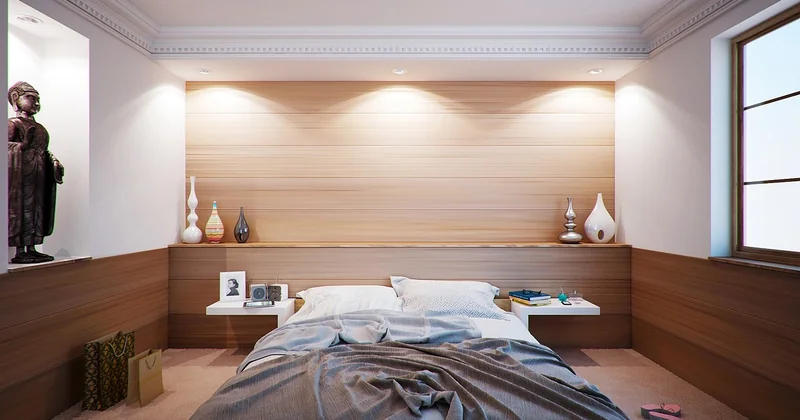
Why one? Because a trend is a bet on the future, and bets are safer when they're small and reversible. A trend expressed through a rug, a lamp, or a single chair can be replaced for the price of a nice dinner out. A trend baked into a fitted wardrobe cannot.
How I apply it
The base is boring on purpose: neutral walls, durable flooring, a large sofa in a color that's lasted a century, or close to it. On top of that base, you place your one loud object. Right now, that object might be a curved bouclé chair, a chunky terracotta lamp, or a secondhand piece with real age to it.
Then, three years later, when the loud object feels tired, you sell it and buy a new one. The base never moves. Total cost of staying current: one object instead of a room.
The mistake I made — the mushroom sofa — was treating a fad as if it were a base. It wasn't. It was a signature piece wearing a base's clothing, and it cost base-level money.
Materials that hold their value when the trend moves on
If you only remember one buying rule, make it this: natural materials age; synthetic ones date. A solid oak table gets a scratch and gains a story. A veneer-topped table gets a scratch and loses its finish. That difference compounds over years.
The category that's grown fastest in my own sourcing is recycled and reclaimed material — stone offcuts, reclaimed timber, recycled glass. It's no longer a niche choice for people with strong opinions; it's simply where a lot of good furniture now comes from, because it's both cheaper and more interesting than a factory-standard finish.
A quick test you can run in a showroom
- Flip the price tag over and look at what it's made of, not what it looks like.
- Ask yourself: if this gets a visible scratch, does it look worse or better?
- Check whether the finish can be repaired or only replaced.
- Decide if you'd still want it with a different color of wall behind it. If not, you're buying the trend, not the object.
It takes ninety seconds. It has saved me from at least two purchases I would have regretted within a year.
Does any of this work in a small space or a small budget?
Yes, and often better, because the one-signature-piece rule is naturally a small-space rule. A studio apartment can't hold ten trends anyway, so the constraint does the editing for you.
Adapting the trends to a small footprint
- Go vertical with texture — a tall linen curtain, a floor-to-ceiling panel — instead of adding furniture.
- One curved piece reads as intentional in a small room; three read as clutter.
- Warm colors do more work in small rooms than in large ones, since there's less space to fight the coolness.
- Reclaim floor space by choosing a lighter wood tone; heavy dark floors close a small room in fast.
Budget-wise, prioritize in this order: lighting first, textiles second, furniture last. A cheap rug under good light looks better than an expensive sofa under bad light. I've watched this be true in room after room, including my own, where the single biggest visible improvement came from a lamp I found secondhand for a fraction of what I'd budgeted.
How to tell a real trend from a two-season fad
Ask whether the trend changes how a room feels or only how it looks in a photo. Warmth, texture, and natural materials change how a room feels every day you're in it. A specific trendy silhouette changes how it looks to someone scrolling past it.
The second test: does it show up in ordinary homes, or only in styled shoots? A trend that's already reaching ordinary apartments — warm bulbs, secondhand furniture, mismatched chairs — is a real shift. One that only exists in professionally lit photos is usually a campaign.
Third test, and the one I trust most: would you choose it if no one would ever see it? If the honest answer is no, you're decorating for an audience, and the audience moves on faster than you do.
Questions I get asked most
Should I follow trends at all?
Yes, but only in the removable layer. Let trends live in rugs, lighting, and single accent pieces. Keep the fixed surfaces — walls, floors, built-ins — in neutral, durable finishes so a trend change never becomes a renovation.

What's the biggest mistake people make with home decor trends?
Buying a matched set. A full matching collection locks you into one moment and one palette, and it's the fastest way to make an expensive room look dated. Buy pieces that share a mood, not a catalog number.
Do warm colors work in small or dark rooms?
Usually yes. Warm tones reflect light more kindly than cold grays and make small rooms feel enclosed rather than exposed. Test a swatch on the wall at different times of day before committing.
How much should I spend on a single statement piece?
Enough that it feels like a decision, not a splurge. If replacing it in three years would hurt, you've spent too much on something that was always temporary.
What to do this weekend
Pick one room. Don't buy anything yet. Walk in, sit down, and name the single object doing the most to make the space feel generic — the thing you'd never defend if a friend asked why it's there.
That object is your starting point. Remove it, or move it, and see what the room does without it. Most people find the space immediately reads as more intentional, and they haven't spent a cent.
The trends in this article are real, and the shift toward warmth, texture, and natural materials is one I expect to still look right a decade from now. But the reason it'll look right isn't that it's trending. It's that it's built on a base you didn't bet against yourself to create — and the only person whose taste has to survive the next ten years is the one living there.