You've just signed a lease on 38 square metres, the landlord has handed you a set of keys, and the place has exactly one power outlet in the bedroom, walls the colour of weak coffee, and a wardrobe that looks like it lost a fight with a flat-pack factory. You can't knock down walls. You can't rip up the floor. But you can make this place look like you meant it.
I've rented five apartments in eight years, and the fourth one — a 32 m² studio where I lived for two years — taught me more about small space interior design for renters than any magazine ever did. Mostly because I made every expensive mistake first. This is what actually works, what the deposit-eating disasters look like, and how to arrange a tiny room so it doesn't feel like a hostel.
Key takeaways
- Every change you make should be reversible. If you can't undo it in an afternoon, don't do it.
- The 3-5-7 rule gives you a proportion for arranging decorative objects — three items, then a group of five, then a group of seven — and it works as well on a rented shelf as on a bought one.
- No-drill fastenings, tension rods and removable wallpaper carry almost the whole load of rental-friendly design.
- Circulation matters more than furniture. You need at least 60 cm to walk and closer to 75–90 cm for a comfortable main path.
- Budget roughly €300–600 to transform a small room properly; anything above that is vanity, not function.
- The biggest danger isn't the landlord. It's you filling the place to the ceiling.
What the 3-5-7 rule in decorating actually changes in a rented room
The 3-5-7 rule isn't a law of physics. It's a styling habit: you arrange objects in uneven groups — three, then five, then seven — because odd numbers read as a composition while even ones read as a pair or a stack. Put three objects on a shelf, a group of five on a sideboard, seven books on a lower ledge. Uneven counts force your eye to move, and when your eye moves, a room feels less static.
Does it work? Yes, in a limited way. I'll die on this hill: it's the single fastest styling trick for a rented shelf you can't paint or recess. But it's a finishing touch, not a plan. If your sofa is shoved against a radiator and your only lamp is a bare bulb, no arrangement of three ceramic vases will save the room.
How to apply the 3-5-7 rule in a room you can't modify
Start with the surface you see most. For most renters in a small flat, that's the top of a low bookcase or a windowsill. Then:
- Group three objects that vary in height — a tall vase, a small candlestick, a flat dish.
- Build a five-item group elsewhere at a different height, mixing something functional (a stack of books) with something decorative.
- Leave the seven group until last, and use it for the loosest, most casual arrangement — leaning frames, a trailing plant, a bowl.
The catch? Don't do all three groups in the same sightline. If everything is grouped, nothing is. And if you rent a furnished flat where the furniture isn't yours, the 3-5-7 rule is your cheapest intervention — the objects travel with you when you leave.
The five rental-safe fastenings that do the heavy lifting
Here's where most rental guides get vague. So, concretely:
- Adhesive strips rated for the load — check the rating on the pack, not your optimism. A framed print is fine; a cast-iron shelf is not.
- Tension rods inside a window recess or between two walls: curtains, a drying rail, a light divider.
- Over-the-door hooks and rails — the least glamorous and most-used item in my flat.
- Removable wallpaper panels for one accent wall, sold in peel-and-stick sheets; the decent ones come off cleanly, the cheap ones take paint with them.
- Freestanding shelving instead of wall-mounted units. You lose a bit of floor, you gain your deposit back.
One thing to check before you buy anything: your lease. Many standard tenancy agreements in the UK, France and Germany allow picture hooks with small nails if you fill and paint afterwards, but ban structural changes and require written permission for anything drilled into tile. Read the clause. Photograph the walls before you start. I skipped that step once and spent a Saturday morning spackling.
How to make a rental apartment look good without permission
Light first. Always light first. A single overhead bulb in the middle of a small room flattens everything — shadows vanish, corners look grey, and the whole space reads as temporary. Swap the shade (it's usually the tenant's to change, and if it isn't, the landlord won't notice a shade swap), add two lamps at different heights, and put a warm bulb — around 2700K — in each one. Your room will look twice as expensive for the price of two lamps.
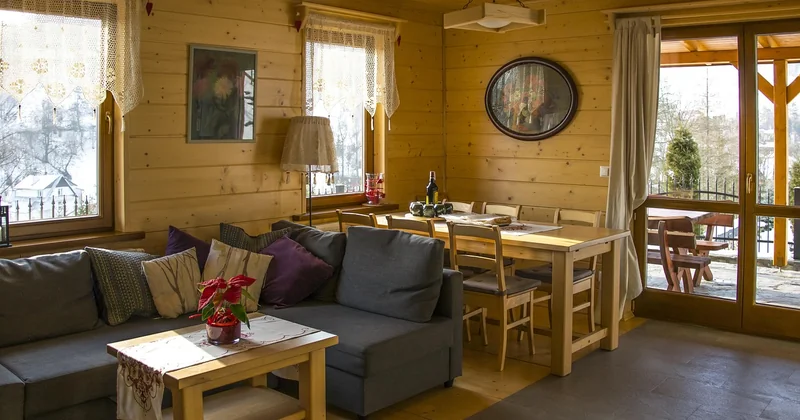
Then deal with the floor. If the carpet is beige and tired, a large rug anchors the seating area and hides most of it. The sizing mistake I made for years: buying a rug that floats in the middle of the room like a postage stamp. It should sit under the front legs of the sofa, ideally under all of them, and extend past the coffee table.
Curtains, walls and the two decisions that matter most
Curtains are the highest-return item in a rental, full stop. Hang them high — within 10 cm of the ceiling, not just above the window frame — and wide enough that they overlap the wall on both sides. The window looks bigger, the ceiling looks taller, and nobody notices the original track you left in place. Tension rods make this possible without a single hole.
On colour: a small room doesn't need to be white. That advice is decades old and half wrong. What a small room needs is continuity — one wall colour carried onto the ceiling, or a tone close to it, so your eye doesn't hit a hard horizontal line at the top. Renters can achieve this with removable panels on one wall and nothing on the others. It's not a full repaint, and it changes the room more than any furniture swap.
What if the landlord's light fixtures are hideous?
You have two options. Replace the shade and store the original in a cupboard (do this — you'll need it at move-out). Or leave the fixture and simply never use it: two floor lamps, one behind the sofa and one near the reading chair, so the ceiling light becomes decoration. Roughly a third of rented flats I've seen have exactly one fixed light per room. Work around it rather than fight it.
How to furnish a small apartment without filling it
The multifunctional-furniture advice you'll read everywhere is true but incomplete. An ottoman with storage is great. An ottoman with storage you can't reach because it's wedged behind a chair is a box you never open. The real principle is one clear function per zone, not one object per function.

So map the room on paper before you buy anything. Mark the door swing, the radiators, the outlets and the window. Then draw the walking path from door to window — that path needs 60 cm minimum, and closer to 75–90 cm if it's the route you use twenty times a day. Whatever furniture doesn't fit around that path is furniture you don't own yet.
A furnishing order that actually works
- Sofa and bed first, placed to leave the main path clear. Everything else negotiates around them.
- Storage second, and vertical: a tall narrow bookcase takes less floor than a wide low one with the same capacity.
- Table third. A drop-leaf or wall-mounted folding table is the standard renter fix, but measure the open position — plenty of "space-saving" tables need 90 cm of clearance when extended.
- Rug, curtains, lamps last. This is the order I got wrong for years, buying decor before I'd solved the layout.
One detail worth knowing: in a studio, the bed is the room. If you can, orient it so it isn't the first thing you see from the door, and use a low divider — a bookcase back-to-back, or a curtain on a ceiling track — to suggest two zones without building a wall. In my 32 m² place I put a tall bookcase between the bed and the sofa and it did more for the feel of the flat than anything else I bought.
What should you actually spend?
Set a ceiling before you start and stick to it. My working numbers, from experience:
- Lamps and bulbs: €60–120 for two decent floor or table lamps.
- Curtains and tension rods: €50–100, depending on window size.
- A large rug: €80–200. This is where cheap rugs look cheap.
- Storage: €100–250 for a tall bookcase or a pair of stacking units.
- Damage reserve: keep €50–100 aside for filler, paint and adhesive remover at move-out. You will need it.
Which brings up the cost of errors. In my second flat I hung a shelf with the wrong adhesive on a painted plasterboard wall. Two months later it came down at 3 a.m., took a strip of paint with it, and cost me €180 out of a €600 deposit. The lesson wasn't "avoid shelves." It was "check the wall type before you trust a strip."
How do you design a small living room you can actually use?
A small living room fails for one of two reasons: the furniture is arranged for the room and not for people, or there's nowhere to put anything down. Fix the second one first. Every seat needs a surface within arm's reach — a side table, a stool used as a table, a narrow console behind the sofa. Without it, your coffee table becomes the dumping ground and the room never looks calm, no matter how well you styled the shelves.
Then float the furniture away from the walls if the room allows it. Pushing everything against the perimeter is the classic small-room reflex, and it creates a dead zone in the middle that makes the space feel smaller, not bigger. Pulling the sofa 10 cm off the wall and letting the back of a chair define the other side of the conversation area — that works in rooms from about 10 m² upward.
Circulation and proportions: the numbers to remember
| Element | Working measurement | Why it matters |
|---|---|---|
| Main walking path | 75–90 cm | Below that, you'll sidestep constantly and it feels cramped |
| Minimum gap between furniture | 60 cm | Enough to pass; not enough for two people with coffee |
| Sofa-to-coffee-table distance | 40–45 cm | Close enough to reach a cup, far enough to cross your legs |
| Pendant light above a table | 75–85 cm above the surface | Below 70 cm it hits heads; above 90 cm it stops lighting the table |
| Rug under a seating group | Front legs of all seating | Smaller rugs make the room read as fragmented |
| Mirror placement | Opposite a window | Doubles daylight in narrow rooms |
The pendant figure is the one renters ignore most, usually because the existing pendant is fixed and the landlord isn't moving it. But if you can change the cable length — many pendants have an adjustable flex — it's a five-minute change that makes a dining nook feel deliberate.
What are the most common rental mistakes?
Four errors, in order of how often I've seen them:
- Filling every wall. A gallery wall in a 12 m² room swallows the space. One large, well-hung piece beats nine small ones.
- Buying furniture you can't dismantle. A solid oak wardrobe is lovely until you move. Flat-pack isn't a compromise in a rental; it's the correct choice.
- Ignoring the lease before drilling. Photograph the walls, keep the spackle, fill and paint before you hand back keys.
- Skipping the rug. Bare floors in a small room amplify sound and make everything feel unfinished. It's the one purchase that changes the acoustic and visual character at the same time.
And one quieter mistake: decorating for the photos rather than for the evenings you spend there. Every rental guide — including this one — will tell you to buy a diffuser and a throw. Buy the throw if you're cold. The room is for you, not for a camera.
You won't get the flat you'd design from scratch. You'll get something better, in a way: a set of decisions you can undo, carry with you and improve. The lamp you buy this year lights the next three flats. The 3-5-7 grouping on your bookshelf takes ten minutes and costs nothing, and when you move, it moves with you.
Which leaves one question worth answering before you spend a euro: if you had to undo every change in a single afternoon, what would you keep? Start there.