Forty-two thousand dollars. That's what a couple I know dropped on a kitchen renovation three years ago — custom walnut cabinetry, a La Cornue range, a backsplash of hand-glazed Moroccan tile they flew a specialist in to install. When they sold last spring, their agent ran the comps and told them the kitchen added maybe fifteen thousand to the price. Fifteen out of forty-two. They didn't lose money because the work was bad. They lost it because they built a kitchen for themselves and then expected the market to pay for their taste.
That gap — between what a luxury kitchen costs and what it actually returns — is the whole game. Most upgrade advice you'll read online is written for people who want a magazine spread. This article is written for people who want a luxury kitchen that adds lasting value, which is a different and much less glamorous goal.
Key Takeaways
- Luxury kitchen remodels typically recover only around half their cost at resale — the rest is enjoyment value, not investment value.
- Neutral, repairable, timeless finishes hold value; anything hyper-personal or trend-locked erodes it.
- Over-building beyond your neighborhood's price ceiling is the most common and most expensive mistake.
- The "3 kitchen rule" is about workflow (sink, stove, fridge), not about money — and it still governs good layout.
- Spending on invisible infrastructure (plumbing, electrical, ventilation) protects value better than spending on surfaces.
- What you get back depends on your local market as much as on the materials you choose.
Why most luxury kitchen upgrades don't pay you back
Here's the uncomfortable math. A high-end kitchen remodel — the kind with paneled appliances and stone countertops throughout — typically recoups somewhere in the range of half its cost when you sell. Sometimes a little more, sometimes a lot less. A minor kitchen refresh, by contrast, can return closer to 70 or 80 percent of what you spend, despite being a fraction of the price.
That inverse relationship catches people off guard. The fancier the upgrade, the worse the percentage return. Why? Because cost scales with personalization, and buyers pay for function, not for your taste.
When I redid my own kitchen four years ago, I made a version of this mistake. I installed a commercial-style 48-inch range because I genuinely love cooking. It's wonderful. It also required a ventilation hood so large it ate an entire upper cabinet, and rewiring the circuit set me back about $2,800 on its own. Would a buyer have paid extra for that range? Maybe a little. Not $9,000 worth.
Perceived value vs. resale value
These are not the same number, and confusing them is how budgets blow up. Perceived value is what you feel every morning when you walk in. Resale value is what a stranger with a checklist and a mortgage pre-approval will pay. Your kitchen can score a ten on the first and a five on the second.
Nothing wrong with buying perceived value — you're allowed to enjoy your own home. Just don't tell yourself it's an investment when it isn't.
What actually adds lasting value
The upgrades that hold up over time share three traits: they're neutral, repairable, and hard to date. Let me break down the ones I'd defend with my own money.
Layout and workflow first
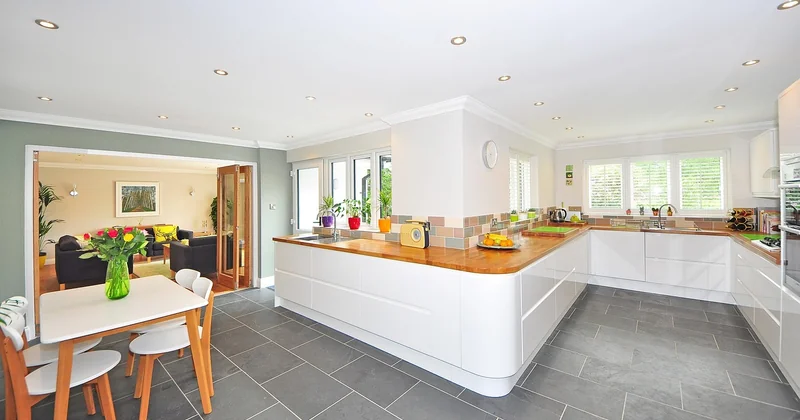
No finish rescues a bad layout. If your sink, stove and refrigerator are scattered across the room, no amount of quartz fixes it. The classic guidance here is the 3 kitchen rule — sink, stove and fridge should form a tight working triangle, ideally with each leg between roughly four and nine feet. It's old advice and it still holds, because human bodies haven't changed even if cabinetry has.
Widening a doorway, removing a wall between kitchen and dining, adding a proper pantry: these are structural moves buyers notice immediately and can't easily undo. They also tend to be the upgrades that survive every trend cycle.
Materials that age instead of expiring
Trendy finishes have a shelf life. A hand-glazed tile in a very specific green reads as "2026" in five years. Natural stone, painted or stained wood in a mid-tone, and warm metals (brass, bronze) all wear in rather than out.
- Countertops: quartz or honed natural stone in a neutral family — avoid aggressive veining that dates fast
- Cabinetry: full-overlay doors in a simple profile, painted or stained, never a novelty shape
- Flooring: hardwood or high-quality engineered wood, refinishable rather than replaceable
- Hardware: unlacquered brass or brushed nickel — both are cheap to swap if taste shifts
Notice what these have in common. Every one of them can be refreshed later for a small fraction of the original cost. A countertop you can live with for twenty years beats a bold one you'll want to rip out in six.
The infrastructure nobody photographs
This is the least exciting and highest-return category. New electrical service to handle modern appliances. Proper ventilation that actually exhausts outside. Updated plumbing that won't fail behind a $40,000 cabinet run. Waterproofing behind tile.
None of it shows up in listing photos. All of it shows up in an inspection report — and a buyer's willingness to pay. I've watched a deal nearly collapse over a kitchen that looked stunning but had a range hood recirculating air back into the room. The buyers walked the inspection and asked for $12,000 off. They got eight.
What kitchen upgrades hurt resale value?
Directly: over-personalization, trend-locked materials, and anything that pushes the kitchen's style well above the rest of the house or the neighborhood.
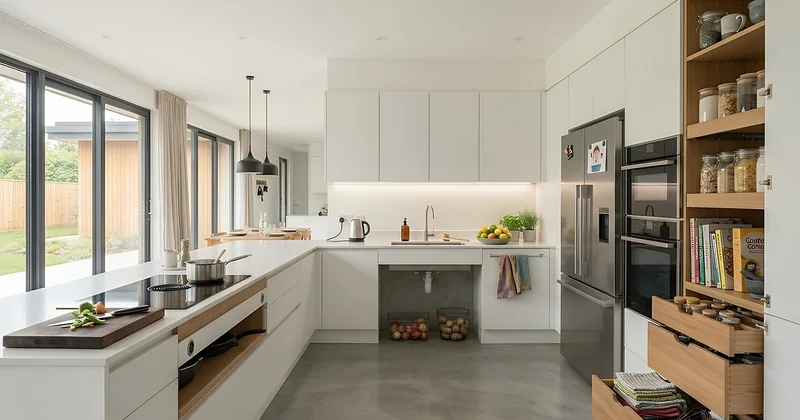
A few specific patterns I've seen go wrong:
- Extreme customization — a built-in coffee system for one brand, cabinets cut to fit a specific appliance that gets discontinued
- Novelty finishes — bright lacquered colors, patterned backsplashes, anything a buyer mentally prices the cost of removing
- Over-building the neighborhood — a $120,000 kitchen on a street where homes sell for $300,000
- Removing function — sacrificing a pantry or dining space for a showpiece island
The through-line is simple. Every element a buyer would need to undo before making the kitchen theirs is a value deduction, not an addition.
What kitchen trends will be outdated by 2026?
By 2026, several things that felt fresh a few years ago already read as dated:

- All-white everything — white on white on white now reads as builder-grade rather than high-end
- Open shelving everywhere, which turns out to be a dust-collection and clutter problem more than an aesthetic choice
- Waterfall-edge islands on every project, so common they've lost their edge
- Cool gray palettes with cool gray appliances and cool gray floors — the "one temperature" kitchen
- Oversized statement hoods that dominate a room visually while doing average work
The direction of travel is toward warmth: warmer wood tones, warm metals, textured stone, layered lighting instead of a single bright grid. If you're planning a remodel now, warmth and texture will look current longer than cool minimalism will.
How to increase home value by $50,000?
Honestly? A kitchen alone rarely gets you there — and anyone promising a precise five-figure lift from cabinetry is guessing. Value comes from the whole picture, and the kitchen is one lever among several.
The realistic path looks like this: a kitchen that's functional and neutral, plus the adjacent improvements that make the space feel coherent. Removing a wall to open the kitchen into the living area. Adding a pantry or mudroom. Upgrading lighting to layers instead of a single overhead fixture. Refinishing floors throughout so the kitchen doesn't sit on an island of new wood in an ocean of old.
The number that matters most isn't the kitchen budget — it's your price ceiling. Find what comparable homes in your area actually sell for, subtract what you owe, and let that constrain your spend. If the top of your market is $450,000 and you're sitting at $400,000, a $50,000 kitchen won't automatically carry you there. It might. It might not. Your local agent will know your street better than any national figure will.
How to tell lasting value from a wow moment
Before you commit to any upgrade, run it through this filter:
| Ask yourself | Lasting value | Wow moment |
|---|---|---|
| Can a future owner change it cheaply? | Yes — hardware, paint, lighting | No — it's structural or built-in |
| Does it date to a specific year? | No | Yes, instantly |
| Does it fix a real problem? | Usually — storage, workflow, light | Rarely |
| Would you regret it if trends flip? | No | Probably |
The upgrades that pass all four columns are almost always the quiet ones. Better storage. Better light. Better flow. The chandelier over the island is a nice touch, but it's the thing you'll be explaining to a buyer in five years, not the thing that sells the house.
So here's the question I'd leave you with: when you walk into your kitchen tomorrow morning, are you upgrading it for the person who lives there, or for the stranger who'll walk through it someday? The honest answer to that determines what you should spend — and neither answer is wrong. Just don't let the second one spend the first one's money.