Walk into a hotel spa and the change is almost instant. The air is warmer. The light is low and layered. Somewhere, water is moving. Your shoulders drop before you've decided to relax. That reaction isn't decoration—it's a set of engineering decisions someone made on purpose. And almost all of them can be rebuilt at home, if you get the order of operations right instead of starting with the pretty stuff.
Most spa bathroom projects fail the same way: people fall in love with a tile and work backwards. I've watched this happen on three separate renovations, including one where the homeowner bought a freestanding tub before anyone checked whether the floor joists could carry the weight of a filled one. Spoiler: they couldn't. That tub sat in a garage for five months while we sistered joists and rerouted a drain. The lesson stuck with me. In a spa-like bathroom, the invisible systems come first and the visible beauty comes second. Every time.
Key Takeaways
- Lighting does more for the spa feeling than any tile or fixture you can buy—layer it
- Ventilation and waterproofing are non-negotiable; nothing else matters if humidity stays trapped
- A luxurious bathroom can be built on roughly $25,000 to $75,000 depending on whether you move plumbing
- Keeping the plumbing where it is cuts costs dramatically and rarely hurts the result
- Warm materials—wood, honed stone, matte finishes—age better than glossy trend pieces
- Accessibility features done well are invisible, and they future-proof the whole room
What actually makes a bathroom feel like a spa?
It isn't the products on the shelf. I've seen bathrooms stocked with every scented candle and rolled towel imaginable, and they still felt like a hotel room someone forgot to finish. The difference is sensory layering, and it breaks into four systems that work together or not at all.
Light is the real luxury
Overhead light flattens everything. It's the single fastest way to kill the mood, and it's the one thing most people never change. What you want instead is three or four sources at different heights, each on its own dimmer or scene setting.
- Warm ambient light from a cove or recessed perimeter
- Sconces at face height on both sides of the mirror—not above it
- A soft pool of light near the tub, low and warm
- Optional accent light behind a freestanding tub or inside a niche
Color temperature matters too. Something around 2700K reads as candlelight-adjacent; anything above 3000K starts to feel clinical. If you're doing a steam shower, use rated fixtures. I made the mistake of specing standard recessed cans in a steam enclosure on one job—they fogged, corroded, and had to be swapped within a year. Not a cheap lesson.
Sound and temperature
Silence is jarring in a bathroom because hard surfaces echo. A little moving water or a discreet speaker fixes the acoustics more than any wall treatment will. Radiant floor heat is the other piece—stepping onto a warm floor in January does more psychological work than a chandelier ever will.
Materials that age well
Honed finishes over polished ones. Natural stone, matte porcelain, oiled wood, unlacquered brass. These develop character instead of showing every water spot. Glossy surfaces photograph beautifully and then spend a decade betraying you.
Get the sensory layer right and the "spa" feeling arrives on its own, without a single branded diffuser.
Spa-like bathroom tile ideas that hold up
Tile is where budgets quietly explode, and where I've made my worst mistakes. On my first full remodel I ordered a handmade glazed tile for an entire shower wall without checking the grout line variance. Six weeks and a lot of wasted material later, I learned that handmade means exactly that.
Format and scale
Large-format slabs cut down grout lines, which cuts down visual noise. A single slab wall behind a tub reads as calm and expensive at the same time. Small mosaic has its place—shower floors, where grip matters—but using it everywhere creates visual static.
| Tile choice | Feel | Maintenance reality | Best location |
|---|---|---|---|
| Large-format matte porcelain | Quiet, modern | Low, easy to clean | Walls, floors |
| Honed marble or limestone | Timeless, warm | Needs sealing, stains easily | Walls, vanity backsplash |
| Zellige or handmade tile | Textured, artisan | High—uneven surface traps soap | Accent walls only |
| Slate or natural stone | Earthy, grounded | Moderate, slippery when wet | Shower floor with grip finish |
Color and pattern
Keep the base palette to two tones and let one accent carry the interest. Warm greige, sand, taupe, soft charcoal. If you want a dramatic moment, put it in one place—a niche, a tub surround—and leave the rest still.
Grout should nearly match the tile in most areas. Contrasting grout draws a grid across the whole room, and that grid fights the calm you're trying to build.
Spa-like bathroom vanity and fixtures
The vanity is the one element you touch every single day, twice, so it's worth spending here. But the spending doesn't go where people think.
What to prioritize
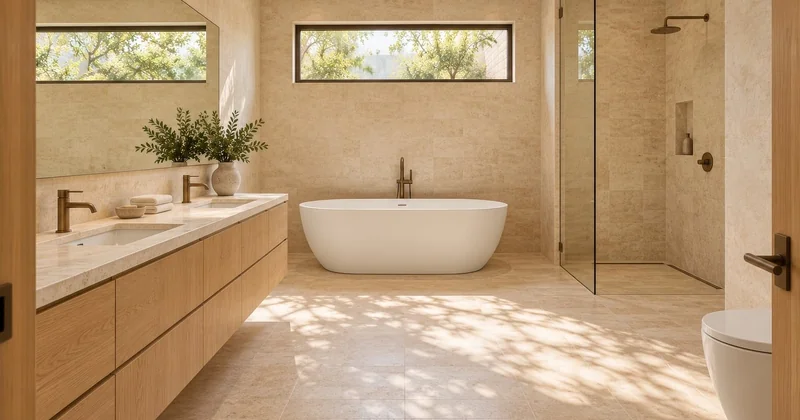
- Wall-mounted faucets, which free up the counter and make cleaning trivial
- A deep, quiet drawer stack over a decorative open shelf
- Under-cabinet lighting that comes on with a motion sensor
- Real stone or solid-surface tops with an integrated or undermount sink
What to skip
Open shelving looks wonderful in photos and becomes a dust and clutter magnet in practice. Vessel sinks are a similar trap—beautiful, slightly awkward to use, and they splash. I've removed more of them than I've installed.
On the tub side: a freestanding soaking tub is worth the floor space if you actually soak. If you don't, a generous walk-in shower with a bench and a hand shower will serve you far better for the same money. Honest question worth asking yourself before you buy anything: when did I last take a bath that wasn't for my kids?
Small spa bathroom design ideas
A small bathroom can feel more spa-like than a large one. Constraint forces focus. The problems to solve are light, storage, and the sense of a single continuous surface.

- Run one material from floor to ceiling to erase corners
- Use a floating vanity to reveal floor and make the room feel wider
- Add a full-height mirror instead of a medicine cabinet with a mirror front
- Put storage in the walls—recessed niches, a shallow cabinet—not on the floor
Glass matters enormously here. A frameless shower enclosure with no visible hardware reads as open space, not a box. And a curbless, walk-in shower removes the visual step that makes tight rooms feel tighter.
Accessibility without looking clinical
This is the info most guides skip, and it's the one that pays off for decades. A curbless shower with a linear drain, blocking installed in the walls for future grab bars, and a bench built into the shower are all invisible when done well. They cost a little more during construction and save a fortune later. Your future self, or your future buyer, will thank you.
The part everyone skips: plumbing, ventilation, and waterproofing
A beautiful bathroom that grows mold is not a spa. It's a liability. This is where luxury homes actually earn their price tag, and where corners get cut invisibly.
Ventilation
You need enough air movement to clear the room after a hot shower, and you need it ducted outside—not into an attic or a wall cavity. An undersized fan is one of the most common mistakes I find. If the mirror stays fogged several minutes after you shower, your fan is too small.
Waterproofing
Every wet area needs a continuous waterproof membrane beneath the tile, with proper slope to the drain and sealed penetrations. The tile is the finish; the membrane is the protection. Skipping or cheaping out on this is the single most expensive shortcut in the trade, because the repair means tearing out the finished work.
Electrical and layout
Fixtures near water need correct protection, and lighting in wet zones needs rated housings. This is not a place to improvise. If this is the moment you're making decisions, here's the practical sequence that has worked for me every time:
- Fix the layout and confirm the plumbing and joist capacity
- Get ventilation and electrical rough-in right
- Waterproof, then tile
- Install fixtures, then lighting and trim
- Add the sensory layer—textiles, scent, sound—last
Notice what's missing from that list: buying the beautiful things. Do them last. They're the reward, not the foundation.
What it actually costs
Nobody wants to give you a number, so here's one. A full spa-style master bathroom in a luxury home typically lands somewhere between $25,000 and $75,000, with high-end builds pushing past that. The single biggest variable is whether you move plumbing. If you don't, you can redirect that money into materials and light—which is where the feeling actually comes from.
Where people overspend: statement tubs they never use, imported tile in low-visibility areas, and hardware that's beautiful but fragile. Where they should overspend: waterproofing, ventilation, and lighting control. Those three determine whether the room still feels good in ten years.
Build the invisible parts generously, keep the visible palette restrained, and light it in layers. The spa feeling isn't a purchase. It's a consequence—of getting the systems right first and letting the beauty arrive afterward, exactly where it belongs.